

My view of politics has changed a lot over the past two years. Here's why.
The United States' complicity in Israel's genocide has caused me to rethink so many things about the world and our politics.

Disclaimer 1: This is a lot of thoughts I’ve tried to distill into a post. It may not be excellent writing…hell, it may not even be well-written at all, but I’ve tried to articulate the thoughts that bounce around in my head and put them into something I hope is meaningful.
I’ve been thinking about writing this for some time now, but every time I sit down to write, I cannot seem to find the best words.1 I realize now that the best words will never be there, and it’s pretty important to share my perspective and growth on an issue that has unexpectedly come to shape and define how I view politics entirely. Some people reading this may not like what I say and question the sincerity of my convictions. That’s fine. But know that I’ve reflected on this a long time, and whether you choose to believe me or not, this is how I feel.
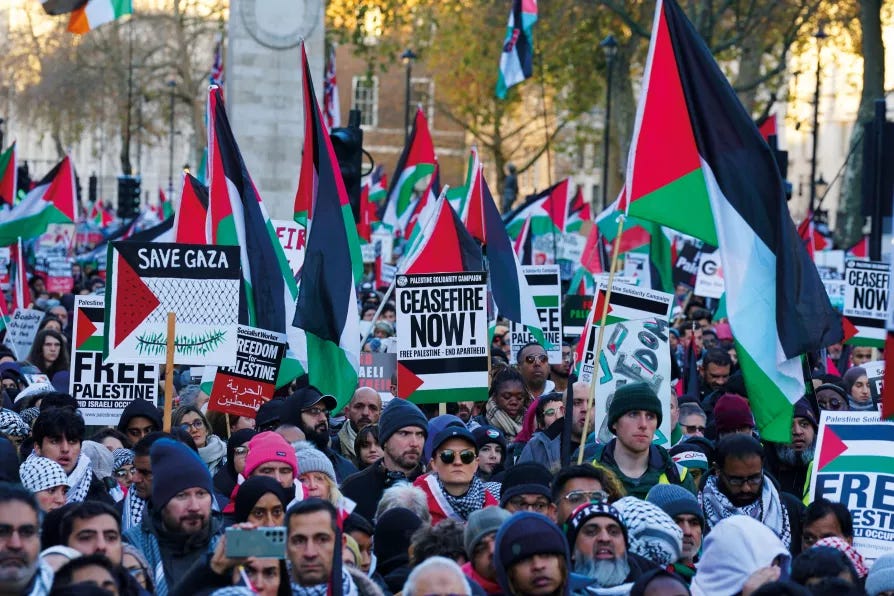
So, to put it simply, Israel’s genocide of Palestinians, and learning more about their ongoing occupation of Palestinian (and Syrian) land and the historic oppression of Palestinians, has changed the way I view and approach politics. Not just because of the abject despicable horror and inhumane nature of these vicious acts of violence—genocide being the crime of all crimes—but how the United States government has been one of the most complicit parties in it aside from the Israeli government itself.
Republicans, and more importantly for this discussion, Democrats, have used our tax dollars to aid and abet the crimes of Benjamin Netanyahu and the Israeli government for decades.2
If you were to ask me 2 or 3 years ago if I’d ever write anything like this, I would be extremely confused by the question. I’d probably look at you with a confused dog head tilt kind of reaction.
Appodlachia has always been about Appalachia, and in my mind at the time, the pertinence of Israel and Palestine didn’t seem relevant to Appalachia. But what I came to understand in early 2024, is that my platform should not be constrained to issues explicitly about Appalachia. I have a responsibility to do what little I can to bring awareness to, and shape the discourse of, things as important as this. And, as the slaughter of Palestinians by Israel intensified, I felt morally compelled to not be silent. I also grew to better understand the history of the region, the history of Palestine, the history of Israel’s assault on Palestinian existence, and the role the United States has played.
As much as this probably sounds self-aggrandizing, I’ve come to realize that my small-ish platform is still important, and building critical mass of pressure often comes from many smaller voices.
How I got here
I want to premise this by saying that before and immediately after October 7, 2023, I was extremely ignorant about this region of the world, the history of Israel’s existence and their occupation/oppression/destruction of Palestine and occupation of parts of Syria, and even the geopolitical issues faced by my ancestral country of Syria. It’s embarrassing how little I knew or understood at the time.3
I did not fully grasp the powder keg cultivated from decades of oppression and dehumanization of Palestinians,4 because I did not know much at all about it. None of this is to excuse what happened on October 7th of course—a horrific and inexcusable attack on civilians—but the history of Israel’s violence against Palestinians cannot be ignored. That violent event itself cannot be fairly compared to the magnitude of Israel’s genocide in its severity and depravity, nor should it.
Several people I knew and trusted at this time were very pro-Israel, and while I’ve never aligned with that ideology, it is easy to look back and see how certain pro-Israel talking points were ones I just accepted, and never questioned. In fact, it’s scary to consider how willing I was to accept certain narratives at face value. I regret that I did not seek to question or clarify earlier than I did.
An example: people telling me that the accusations of apartheid, occupation, and genocide were just “far left talking points” and “antisemitic”.
Because I was extremely ignorant of the history behind Israel and Palestine, I didn’t feel like I had a leg to stand on to question the explaining away of these accusations. I also was aware of the rising antisemitism happening in this country over the past decade, such as the Tree of Life massacre and the Unite the Right rally in Charlottesville, and was fearful that I could be contributing to that by entertaining any of those accusations. I didn’t think about the fact that the alternative of explaining away those accusations could be, in and of itself, a form of Islamophobia.
I lacked the confidence of curiosity in the early moments after 10/7 when Israel began what would be its genocide that I very much regret to this day. However, the more I heard not to trust those voices on the “left”5, the more I felt I should listen to them.
At the beginning of 2024, those feelings truly began to consume my every day thoughts.6 However, I still questioned myself and felt like I/Appodlachia didn’t have a place in that public conversation. I told myself “you don’t need to feel obligated to comment on everything, especially on issues that are complex that you know little about.” That framing, as it turns out, was a huge part of the problem that I take ownership of. 7
It wasn’t until a friend of mine from high school reached out to me about it, noticing the absence of Appodlachia—then a fairly well known entity regionally—speaking out against it. I am grateful she did, because she challenged me on many things I thought I knew about Israel and Palestine, compelled me to actually educate myself extensively on it, and pushed me to use my platform in a way that could, at the very least, try to make a small difference. I look back on these conversations and am extremely grateful for their patience and their willingness to push me on something that I otherwise felt extremely unequipped to discuss.
I spent the next several months reading as much as I could, listening to trusted voices on Palestine, and following Palestinian journalists who put their lives on the line every day to desperately get the truth out to the world. What I saw was a reality entirely different than what many mainstream media outlets were covering, what most politicians were saying, and what I had previously believed about Israel’s relationship with Palestine. Seeing a reality on the ground so radically different than what you’ve previously been led to believe is jarring, and can re-wire one’s worldview.
How this changed my view of politics.
Bear with me as I attempt to articulate how I feel here. I don’t know if this will translate all that well to words on a blog post thing.
As a TLDR: Israel’s genocide and the political decisions that led to the U.S. complicity in it, have made me shift my view of politics and elections, mostly in terms of what should be deemed acceptable from certain democrats. It has caused me to mostly reject ideas of incrementalism and being accepting of mediocre democrats who “are more likely to win” as a strategy for what is best. In short, we need to be relentless and unwavering in our demand that we get better democrats and independents representing us rather than just focusing on getting more of them in office. Shifting the way we think and talk about political ideology is key to accomplishing this.
We don’t have to settle for a centrist corporate politician just because the “politics of the state/district demand it.” Our collective voices can have this power. We’ve seen how much the country has shifted in their views on Israel, and how this started to translate politically among democrats in Congress and those choosing to run.8 My approach has mostly been about getting bad republicans out of office and less about getting good democrats in office. That has changed.9
Ideology is not about “left/right/center”, it’s about the rich vs. the rest of us.
I feel now, more than ever, it is important to shift the way we view ideology. Pundits and many people who do politics for a living will insist the ideological spectrum in the country is left - right - center, while ascribing the stereotypical policy viewpoints akin to each. This has been the norm for decades, and is so thoroughly ingrained in how we talk about politics that it is the default setting for most electoral discussions. How many times have you heard “[candidate] needs to become more centrist to win an election” or “they’re views are too far left.”10 This hits SO HARD if you are financially comfortable and divorced from the reality of most people in this country. You can even find polling and data to back up this viewpoint.
Its a useful framing because it simplifies complex topics of public policy. And if we know anything about simplifying things in politics, it often works to win elections (“Build the Wall”, “MAGA” etc.). But what I have come to realize is this is a dated and irrelevant way of viewing our country and the electorate. I felt this in general for a while, but it has intensified in the past two years (I’m getting to how this relates overall to Israel and Palestine, just bear with me and let me land this plane on a long runway).
The dynamic is not a left-center-right, it’s the rich versus the rest. The widening income inequality gap has been so stark and significantly these past decades, and it’s no coincidence that Trumps fake ass economic populism was so successful. People are struggling. Future generations have no hope for being financially comfortable. More people are realizing the American Dream is a lie. We are teased with the upper crust before it is swiftly taken away from us every single time, then we’re told we don’t deserve things like universal healthcare and paid family leave.
For most of my adult life, and the majority of the time I’ve done this podcast, I’ve held the worldview that, in general, Democrats are better than Republicans, and that they should appeal in a way that is most “electable” in order to move the ball forward, so to speak (in other words, incremental progress). I was a lot less inclined to criticize Democrats because I felt that energy is best spent on criticizing and mocking republicans—whom I believed to be much worse than most, if not all, Democrats.11
To an extent, I still believe a lot of this, but I’ve become more cynical about Democrats and their ability to bring about the change needed to materially improve the lives of regular people, myself included. To be clear, elected Republicans (especially in Congress) have been far far worse than democrats as a whole, especially given their embrace of fascist authoritarianism.
The vast majority of democrats in power chose to side with Israel in their genocide of Palestinians. Yes, a handful in Congress have been very critical of Israel and tried to do what they could to change the U.S. foreign policy trajectory on the matter, but they are by far the outlier.12 For the most part, Democrats have been lock-step in their support of Israel.
Does it mean I think people shouldn’t vote for someone like Mark Kelly in Arizona when he ends up running against a bootlicking hardcore MAGA republican? No. If a binary choice is presented when in the voting booth, practicality should take over, particuarly when other things like reproductive rights are on the line.
Voting is a calculated action where you choose the best vehicle of the options available to you to effectuate the worldview you want. It should be divorced from emotion, and should be viewed as one of many tools in the advocacy toolbelt.
However, Kelly should be pressured relentlessly to change his views, and droves of democrats in the state threaten to withold their votes for him if he doesn’t shift his viewpoints away from funding Israel’s military efforts. We have seen how more and more democratic candidates are rejecting AIPAC/Israel lobbying money that it is quickly becoming the standard approach in many parts of the country. That was UNTHINKABLE only a few years ago. We have seen how much the public’s views on Israel and Palestine have changed in the past two years. Americans have more sympathy for Palestinian lives than ever before, and that is in part because activists have elevated this issue constantly and have shown politicians that it does in fact matter that we are aiding and abetting genocide.
I think there’s is a prevailing belief that it isn’t productive to expect more from democrats. I often hear the refrain “why are you talking shit about [Democrat] when we have a literal fascist in office.” What is crystal clear to me is that if we continue to do this—to only train the focus on Republicans and not getting BETTER democrats, ones who are vicious class warriors with a bold vision to close the inequality gap— we will be doomed to the same failed policies of the past several decades. Shit will continue to get more expensive, the rich will get richer, and the life most of us dream of having will be further out of reach.13 14
Class war over culture wars. We need a democratic party that truly represents an economic populism that is unwavering in its pursuit of policies that incontrovertibly improve the material conditions of the working poor and the average person. 15
We have to stop hug-boxing democrats and hitting them with kid gloves. Most of them have the same capital-friendly worldview that has helped usher in an era of corporate oligarchy and massive income inequality.
Electoral consequences for Democrats that don’t evolve and align with class-first politics. Democrats must be held to a much higher standard, and a different one than I previously thought necessary. We have to demand better from the ones in power, and provide real electoral consequences when they fail to abide by the will of the people.
Support for Israel’s genocide can be boiled down to a class issue, and continued support for the genocide should have severe electoral costs. The U.S. has sent Israel almost $18 billion just since October 2023. By many estimates, that would be enough money to end homelessness in this country. Any Democrat who still supports funding Israel’s genocide should be primaried relentlessly. The slaughtering of innocent Palestinians and further occupation of their land will not stop if the U.S. continues to fund Israeli military projects.
There needs to be a broader mechanism for initiating these efforts and funding challengers, which is something I hope to work on figuring out a solution to.16
If this sounds like pie-in-the-sky thinking, I kindly invite you to compare and contrast the Republican Party of 2015 with today. In 10 years (and let’s be for real, it took way less than 10) one man fundamentally reshaped an entire party. It is a proof of concept that it is in fact possible to do that with a major political party. I’m not suggesting we nominate an authoritarian, I am simply saying that the appetite for radical change exists among people in this country, and we can translate that into a political apparatus reflective of that.
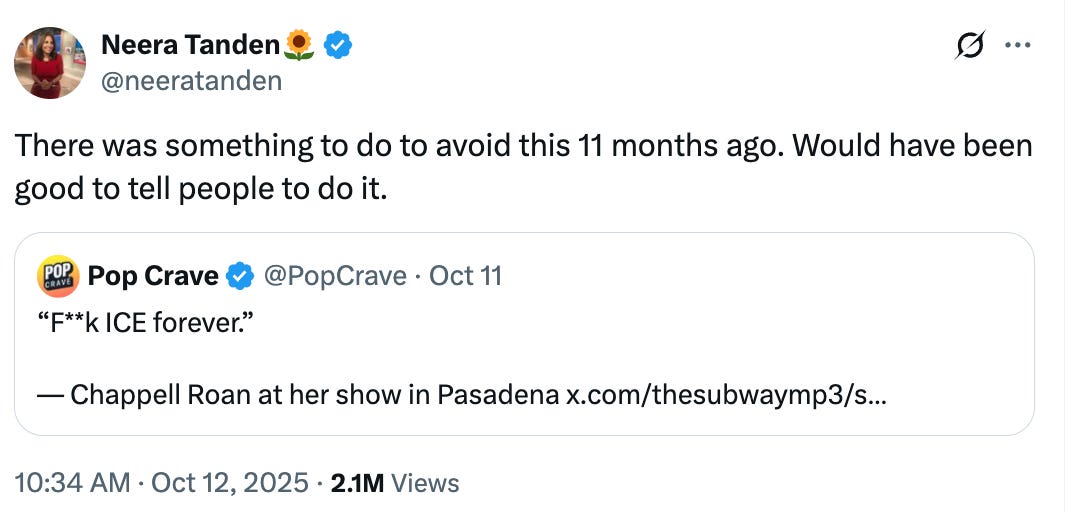
The truth of the matter is if we do nothing to change the status quo of the democratic party - to force it to change into an apparatus for advancing truly class-centered pro-worker policies - we will only repeat this deadly cycle.
The genocide started under a democrat president. Joe Biden couldn’ve made ONE phone call to Netanyahu and ended the genocide, because Israel is so heavily reliant on U.S. arms and aid. But he didn’t. And the party establishment, by and large, backed him up every step of the way.17
Let’s land this plane, Chuck
To wrap this all together: Israel’s genocide radicalized me to completely reshape my view of politics. It has shown me that we must be extremely bold in our demands to democrats, that incremental progress is not enough, and that—for the Democratic Party to survive and be a relevant force in electoral politics—it must evolve into a vehicle that advances class-warrior candidates who make everything about the rich vs. the rest of us. This is the only way we can materially improve our conditions.
I know many of yall on the “left” have been saying this for years. I regret it took me so long to abandon the prism of practicality politics as it is clear that, in most instances, it has failed to meet the needs of people.
I may continue writing on this, because I’ve re-read it several times and still think I’m struggling to communicate my viewpoints coherently, but I digress!
This is a list of people I’ve paid close attention to and learned about Palestine/Israel from. This is neither a full nor exhaustive list, but a handful of people I find particularly important:
Dropsite News, especially Jeremy Scahill
If you like what I do/write, you can help support my work by upgrading to a paid subscription tier on here, or join my Patreon, where I post exclusive videos and other cool perks for subscribers.
The usual disclaimer: These are personal opinions. They are not reflective of my employer and never will be.
I’ve also been hesitant out of fear of saying something wrong, or not considering additional context, or failing to mention important details.
If you have any doubt about the depravity and racism coursing through his administration, a quick google of his Minister of National Security, Itamar Ben-Gvir, should help you reach a solid conclusion.
Despite not being knowledgable of the history between Israel and Palestine, I have always believed that Palestinians had a right to self determination and to have their own state. I just never engaged on the issue beyond this.
The Nakba, the Israeli blockade of the Gaza Strip, the illegal occupation of the West Bank and Golan Heights by Israel, and their apartheid system of government just to name a few.
It will become clear soon why I put “left” in quotes.
This isn’t hyperbole. Nor is this an attempt to evoke any sympathy whatsoever (I’m a guy with a computer job living in a place not ravaged by war and destruction, I deserve zero sympathy…just to be clear). I genuinely want to convey what I felt and how I came to my conclusions
At this point, a few human rights groups and NGOs began referring to it as a genocide.
It wasn’t enough, but it was a sign of progress and a sign that we can force politicians to be better.
I say democrats, but I also feel like we need a bigger lane for independents and non-Democratic party identifying leftists to run for office.
If you dig deep enough, you’ll find me saying similar things. I won’t pretend that isn’t true.
To be clear, still do believe this about D vs. R
Rep. Rashida Tlaib and Rep. Ilhan Omar in particular stand out to me (I know there are others but those two have been critical for a long time).
If you’re reading this and rolling your eyes like “dude, if this is revelatory to you, you’re an idiot”, its fair to think that. However, my view has always been to focus on getting republicans out of office, and less on getting good democrats in office. This has been a deeply flawed viewpoint.
There are certain leftists who will reject the idea that the Democratic Party is salvageable at this point, and I respect that opinion but disagree with it.
In an ideal world, a candidate wanting the support of the Democratic party should be unequivocally for universal healthcare, paid family leave, a much higher minimum wage, stopping weapons shipments to Israel, etc.
Justice Democrats and other organizations have been working similarly on projects like this, but I think the effort needs to be much more broad and powerful.
The same could be said for Donald Trump in the first 9 months of his second term, fwiw
In an “ideal country” no child goes unfed, no Senior Citizen has to choose between medicine and food, no disabled person is left to just die unattended, no person in the Appalachian Mountains is left to pump and shoot drugs because their government took away every means of livelihood from agriculture to industry leaving them high and dry while funding the massive genocide of innocent people in a far away country that most Americans know nothing about, no politician becomes rich “serving” the People, lobbyists are restrained, term limits are instated, Presidents cannot be Felons, MOCS can’t serve after 60 years of age, taxation of the rich supersedes taxation of the poor, kickbacks are illegal, Citizens United becomes illegal, Public Schools are fully funded, taxpayers don’t fund private schools, no theology is governmentally promoted, no President is shielded from amoral and illegal actions and does not have the capability of pardoning anyone associated with any act of insurrection ever, Joint Chiefs of Staff with lifelong Military careers cannot be fired without any kind of due process going through the Military itself, no “Golden Shield” protects a President from bombing ships with the excuse they carry drugs or anything else anywhere anyhow or murdering innocent people without international court agreement, gerrymandering would be illegal, the vote would actually be the Voice of the People with a full account-no more electoral voting, higher education would be free, the Military would not be enabled to torture people in American cities regardless of their ethnicity or color, history would be taught correctly in every school and racism as a systemic American Failure would not be avoided, all people could and should marry who they live, LGBTQ+ should not be a governmental policy, women would finally be free to own their bodies and be considered equal. We CAN do this. Collectively we can move this country into its greatest potential—here’s the clincher: finding the People to help us get there. Trust me on this, they aren’t over 50 years old. I am a Senior Citizen. Let’s focus on young people whose ideology is more profound than the Chuck Schumer’s of this world. United, yes, we can.
You have the words—they spoke straight to my own heart.
I identify deeply with everything you say, thank you for articulating it. Money poisons everything; my senators, Chuck Schumer and Kirsten Gillibrand won’t dare to deviate from their pro-Israel rhetoric for fear of losing their AIPAC money.