


You may have seen the news recently about Tennessee’s GOP supermajority legislature redrawing their congressional maps to break apart a majority-Black district. It’s time to talk about it. All of it.
This is a long post, but I believe the details are v necessary for understanding this very serious and disturbing situation.
So snuggle up in your favorite chair, pour yourself a glass of the vice of your choosing1, and lock the fuck in.
First, some very brief “housekeeping”
I am donating 50% of all our merch store profits in May to The Equity Alliance. I’ve got a sale running through Sunday, so check out the store here!
I partnered with the Women’s Equality Center on a video talking about Trump’s corrupt pardon and how it undermines progressive governance. If you have an IG account, I’d love for you to check it out/like/share 😀
How we got here: The Voting Rights Act and its dismantling
If you’re wondering why it took until now for Republicans in Tennessee to redraw the maps to eliminate a safe Democratic seat, it’s because it would have previously violated Section 2 of the Voting Rights Act (VRA). A recent Supreme Court decision delivered a few weeks ago utterly decimated Section 2 — Samuel Alito’s wet dream — and paved the way for the TNGOP to do this. More on that later.
A very TLDR of the VRA
Getting the United States from a country where Black people were bought and sold as legal chattel, to one where Black people have equal rights to white people under the law, is a journey we are still on today. In fact, we’ve backslid quite a bit in the past few weeks.
I could spend hours detailing the events leading up to the the passage of the Voting Rights Act, but I won’t for the sake of brevity. To offer an extremely abridged view of things:
Important civil rights leaders like MLK Jr., James Bevel, Fannie Lou Hamer, and many others had been putting their bodies on the line for years fighting for equal rights and protections under the law.
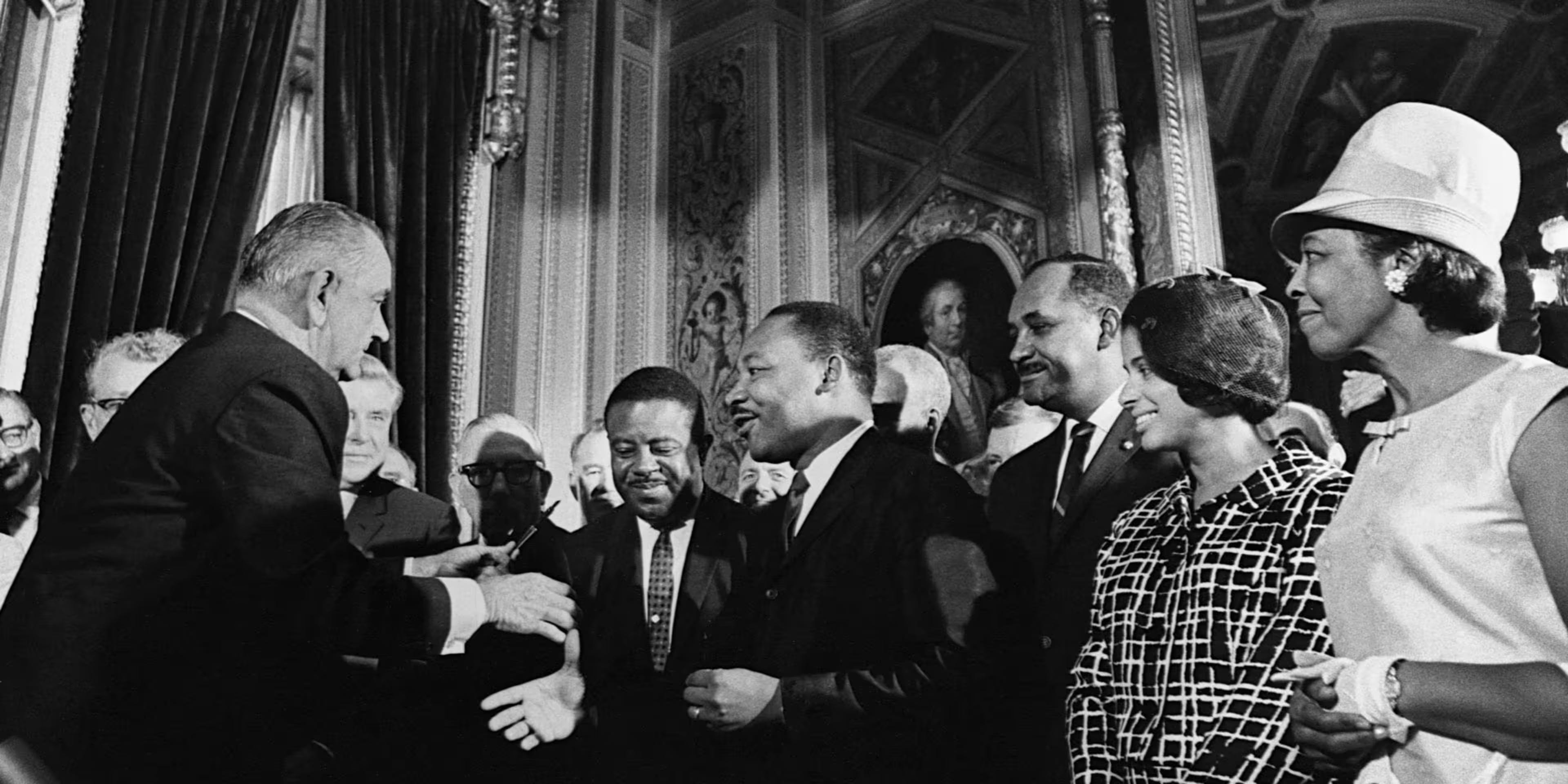
Because the Civil Rights Act of 1964 did not prohibit most forms of voting discrimination, LBJ (Big Johnson) signed the Voting Rights Act of 1965 into law (after more pressure and organizing from civic rights leaders, in addition to the events of Bloody Sunday)
For the purposes of this No Elegy Needed substack post, we’re only going to focus on Section 2 of the VRA.
Section 2 prohibits any voting law, practice or map that results in the “denial or abridgement of the right of any citizen of the United States to vote on account of race or color.” This provision provides a mechanism for challenging laws and maps that were enacted with a discriminatory purpose or have a discriminatory impact. (Source: Democracy Docket)
To simplify: Section 2 allowed (and sometimes, required) the creation of majority-minority districts
To fully understand how we got to the present day: where white Republican lawmakers in Tennessee are diluting a majority Black congressional district, I believe it is important to understand two Supreme Court cases: one that builds the protective foundation for voting rights against racial gerrymandering, and one that dropped a nuclear bomb on it.

Thornburg v. Gingles (1986): How Black vote dilution was fought
Thornburg v. Gingles was a landmark Supreme Court case that dealt with illegally drawn state legislature districts in North Carolina that were designed to dilute Black voting power.
In 1982, the North Carolina legislature drew new state house and senate maps in a way that effectively diminished Black voting power using two methods (one of which was particularly nefarious).
Splitting Black voters among multi-member districts: They chose to draw multi-member districts with substantial white voting majorities in some areas of the state where there were sufficient concentrations of Black voters to form a majority Black single-member district.
Fracturing Black voters into multiple single-member districts: Analogous to what recently took place in Memphis, the NC legislature in this case “fractured between more than one senate district a concentration of Black voters sufficient in numbers and contiguity to constitute a voting majority”
The result of this, at least in the NC Senate, was no district with an effective voting majority of Black citizens.
Black voters bringing this case were given a huge boost at the time by Congress. When the action was pending trial at the district court level, Congress passed a critical amendment to Section 2 of the Voting Rights Act (VRA) that effectively made it easier to prove Black voters were discriminated against.2
The Supreme Court found that the districts violated Section 2 of the VRA, describing it as “vote dilution through submergence.” The Court developed a framework for assessing these claims, known afterward as the Gingles test.3
The broad takeaway here is a district can be found to violate Section 2 of the VRA - that is, depriving Black (or any minority group) voters of an equal opportunity to participate in the political process and elect representatives of their choice, even if that wasn’t the original intent, if the Gingles factors are met.
Louisiana v. Callais (2026): An ideologically captured court creates the judicial permission structure for vote dilution
The Roberts court is awful. John Roberts likes to think of himself as a great arbiter of fairness - his court the sturdy bulwark of justice and impartiality - but the truth is he’s either medically delusional and obtuse, or the worst liar on the face of the planet. Pick your favorite, they are a distinction without a difference at this point.

I won’t go into detail on the numerous cases they have decided that have chipped away at the VRA, but it started in 2013 with Shelby County v. Holder, when John Roberts himself delivered the opinion of the court that struck down Section 4 of the VRA as unconstitutional.
Background to Callais
Louisiana v. Callais, which was decided last month, dealt a near-mortal wound to Section 2 of the VRA.
Black people make up 1/3 of the population of Louisiana, but when the congressional maps were redrawn after the 2020 census, the state had 5 majority white districts, and only 1 majority Black district.
After a lawsuit brought in 2022, it was ruled that the map violated Section 2 of the VRA, and the maps were redrawn to add a second majority-Black district — consistent with the population of the state and its 6 congressional seats.
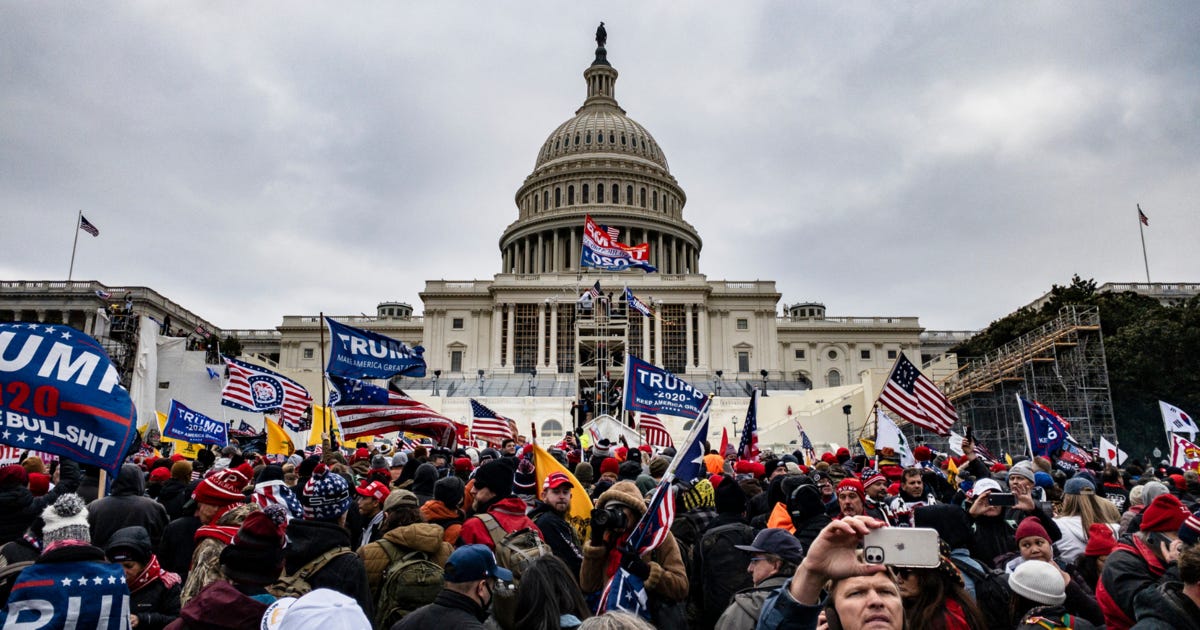
A dipshit J6-er named Bert Callais, along with a group of people who literally called themselves “non-African American voters” filed suit claiming the map was an illegal racial gerrymander, thus violating the 14th and 15th amendments of the U.S. Constitution.
Alito continues his assault on the VRA
To nobody’s shock, SCOTUS issued a 6-3 decision (along ideological lines) affirming that it was an illegal racial gerrymander.
These two bullets sum up the case well enough for the purposes of this post:
The holding said compliance with Section 2 of the VRA was not a sufficient reason (the legal term used is “compelling interest”) to justify the intentional use of race in drawing legislative districts
The Gingles test shouldn’t be thrown out, but updated
Alito said four historical developments happened since Gingles that merit updating the test4
Alito claimed that the world has progressed since Gingles, and merited an update. He said you must now show
That a state redistricted based on race and not party
That racial bloc voting “cannot be explained by partisan affiliation”
This adds an unbelievably difficult barrier to clear when trying to draw a majority-minority district. And this is by design. Samuel Alito is a monster who is ideologically opposed to the Voting Rights Act, and used the machinations of the law to sabotage it at every step of the way
Where we are now: the GOP attack on Memphis
If you have stayed with me this far, thank you. We now have the politics to talk about.
TLDR of what just happened
The TLDR of what recently happened in Tennessee is this:
Of Tennessee’s 9 congressional districts, only one was represented by a Democrat. The others were heavily gerrymandered to favor republicans
That democratic district, TN-09, was mostly comprised of Memphis
Memphis has 610,000 people, 61% of whom are Black.5
Tennessee’s supermajority republican legislature — after the Callais decision came down — redrew the congressional maps, breaking Memphis into three separate districts, diluting Black voting power and creating an R+9 district of TN-09
Memphis
To properly understand the implications of the recent redistricting, I feel obligated to provide at least a little context of Memphis’s history with having to withstand racially -motivated government policy that harmed the Black community.
Let me premise this by saying I am in no way qualified to give a full historical recitation — nor the full context — of Memphis’s history and how it has always been a target of racism and white supremecy. I am not Black. I am not a Memphian. I am not a Black Memphian. My goal with this is to give you, the reader, at least a little context to the city’s history and how its Black residents have been targeted by people in power. I believe it is necessary if you are to understand what we are witnessing currently with the Tennessee Republican Party.
Context to Memphis’s history of civil rights and the struggle for Black liberation
Because Memphis is majority Black, it has been the victim of racist government policies and racially-motivated attacks by white people for a very, very long time. This is by no means a comprehensive list, but I chose an event from the past and one from the present to illustrate how racism against Black Memphians has been a problem since the city has existed.
Memphis Massacre
I never learned about the Memphis Massacre of 1866 until very recently, and I imagine that is the case for many of you reading this. The Memphis Massacre occurred a year after the end of the Civil War.
The city’s Black population had quadrupled in size since the start of the war as it became a safe haven for refugee slaves. Despite the war ending, many white people were not keen on Black people being integrated into society with more rights. A minor altercation between a police officer and Black residents lit a powder keg, and white mobs went on a 2 day spree of violence against Black people living in South Memphis.
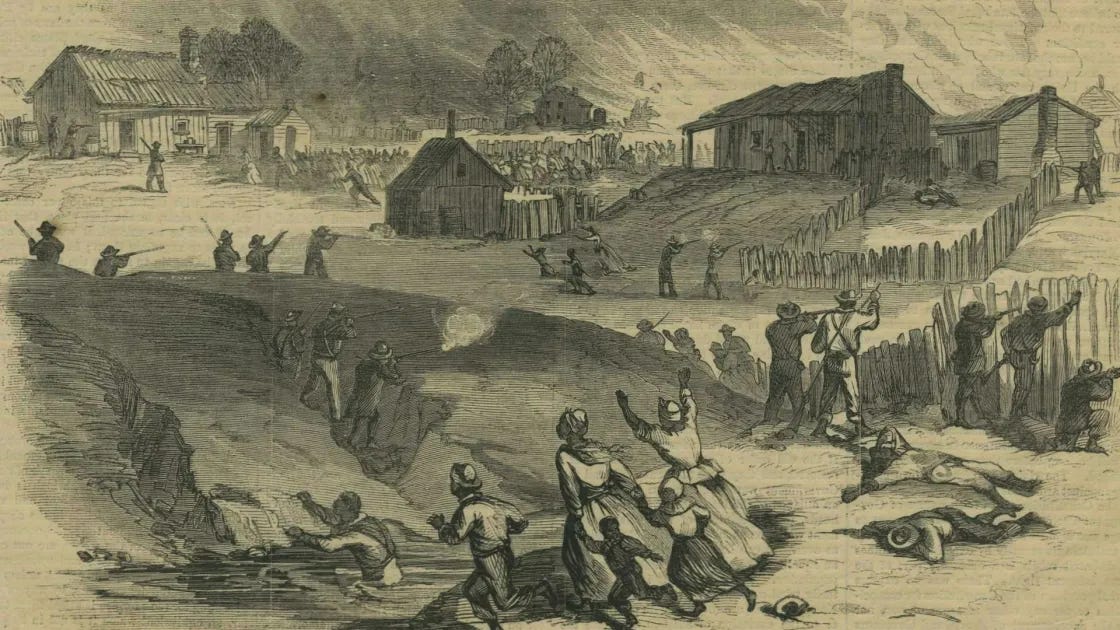
The end result: white mobs killed 46 Black men, women, and children; injured at least 75 others; and destroyed all the city’s Black churches and schools and almost 100 homes.
This is a truly horrific event that caused an exodus of Black people from the city — nearly 1/4 of the population left after this happened, and the state legislature was forced to take over the city’s police force.
xAI facility in Boxtown
Elon Musk didn’t become the richest person in the world by simply “working hard,” and you don’t become a billionaire without exploiting people and stepping on others to get to the top.
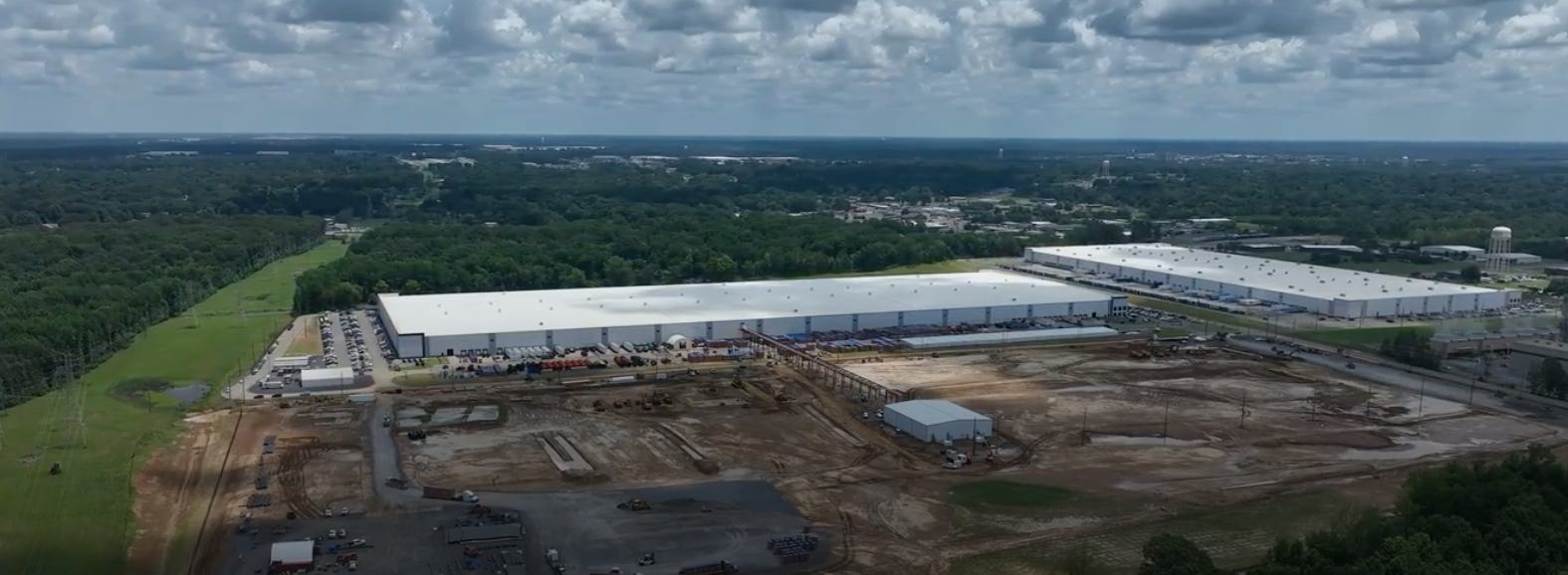
The xAI Colossus data center is perhaps an example of that, in some ways. It is billed as a “supercomputer” and was launched in late 2024 at a former Electrolux site in South Memphis’s Boxtown neighborhood. The location is important: Boxtown is the oldest part of South Memphis, a predominantly Black neighborhood, and began as a community for emancipated slaves in the late 1860s.
One of the biggest concerns is the very real and concerning health implications of the facility. The project is burning a massive amount of methane gas from 27 turbines — enough to power a small city — without pollution controls or federal permits, leading to potential violations of the Clean Air Act among other laws. An analysis by the University of Tennessee (go vols) reviewed data on air quality since the facility was built:
They found that average concentrations of nitrogen dioxide have increased by 3% when comparing the periods before June 2024 and afterward. They also found that peak nitrogen dioxide concentration levels have increased by 79% from pre-xAI levels in areas immediately surrounding the data center, and by 9% in nearby Boxtown.
Physicians have called the jump in peak nitrogen dioxide concentration levels “alarming,” and “significantly increase the risk to residents’ health.”
(Source)
There is evidence that suggest xAI worked with local officials to avoid much of the scrutiny typically required for a project of this size. There has been virtually no public oversight whatsoever, and it was only after major public outcry that xAI got the necessary permits for the gas generators
There is a lot more to this, so I would recommend More Perfect Union’s fantastic reporting on it.
What the district was, and what it has become
Some background on TN-09
Tennessee’s 9th congressional district previously included most of the City of Memphis and parts of the greater metropolitan area, making it a D+23 district. It excluded the wealthy white suburbs of Collierville and Germantown to strengthen TN-08 into an R+21.
TN-09 has been represented by Steve Cohen6 for almost 20 years. Since Reconstruction, Republicans have only held the seat twice, for a total of four terms. It is a as solid D as a district can be, that was, until two weeks ago.
TNGOP does as they are told
When the Callais decision came down a few weeks ago, Marsha Blackburn and Donald Trump wasted no time in commanding their underlings at the state house to redraw the congressional maps to eliminate the last remaining democratic seat in the state.7
The Republican leaders even admitted that the map was created in conslutation with the White House - which isn’t surprising, but further confirmation the party is fully subservient to Trump.
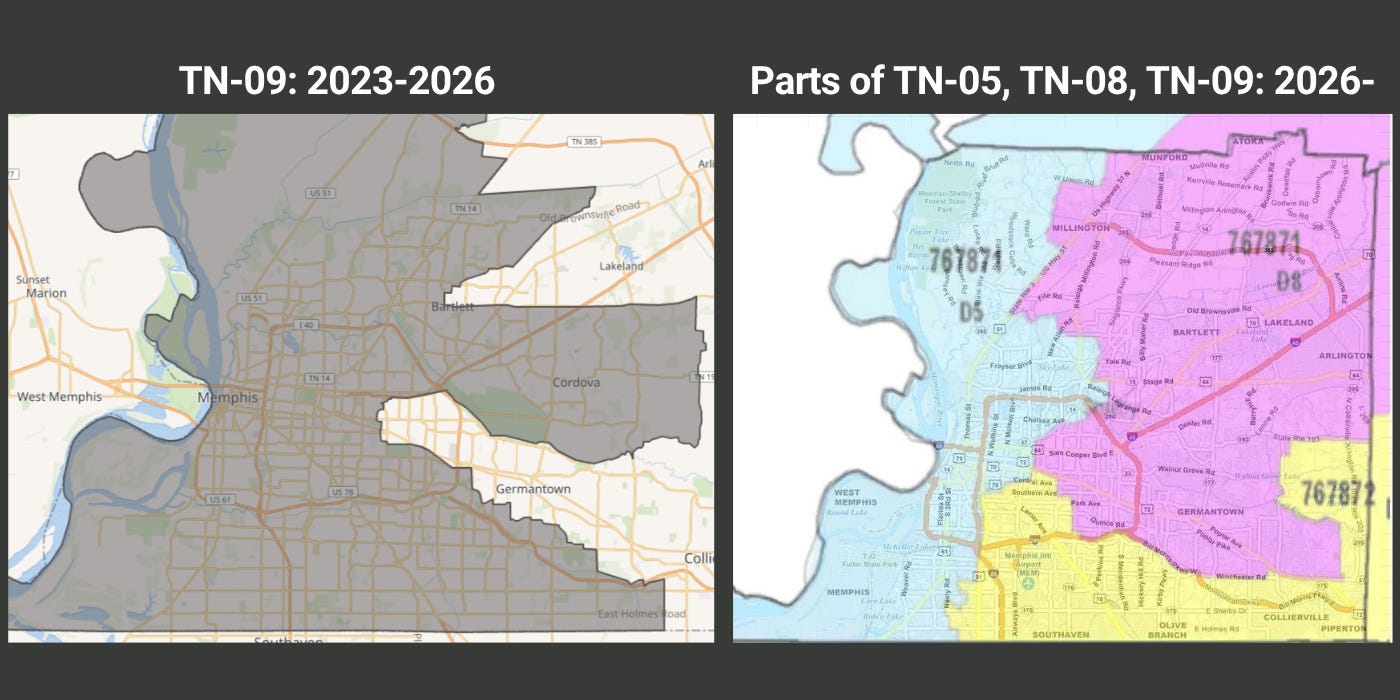

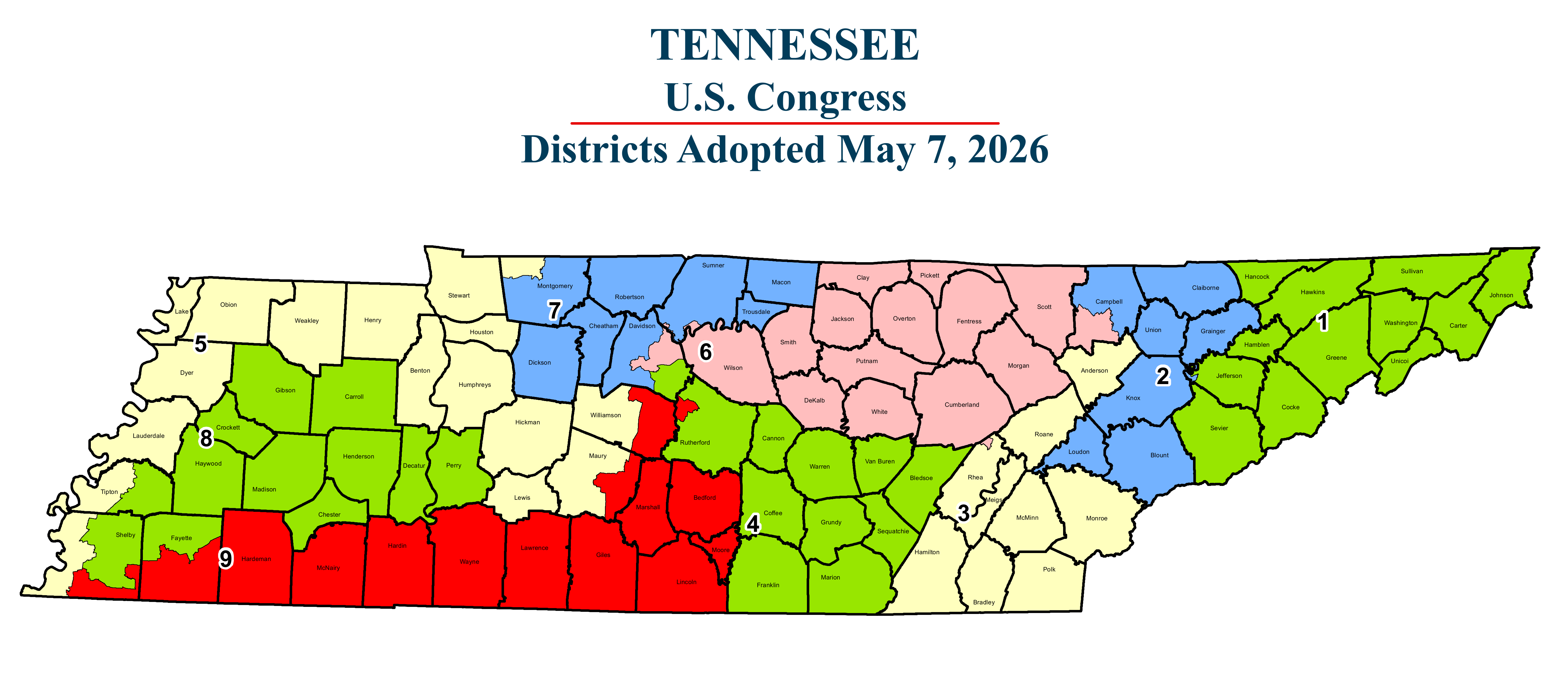
As you can see above, the map was specifically designed to break Memphis apart into three separate districts. As you can see below, the new maps very clearly divide up the Black population of Memphis into three districts, which largely corresponds to how Democrats voted based on election data from 2024
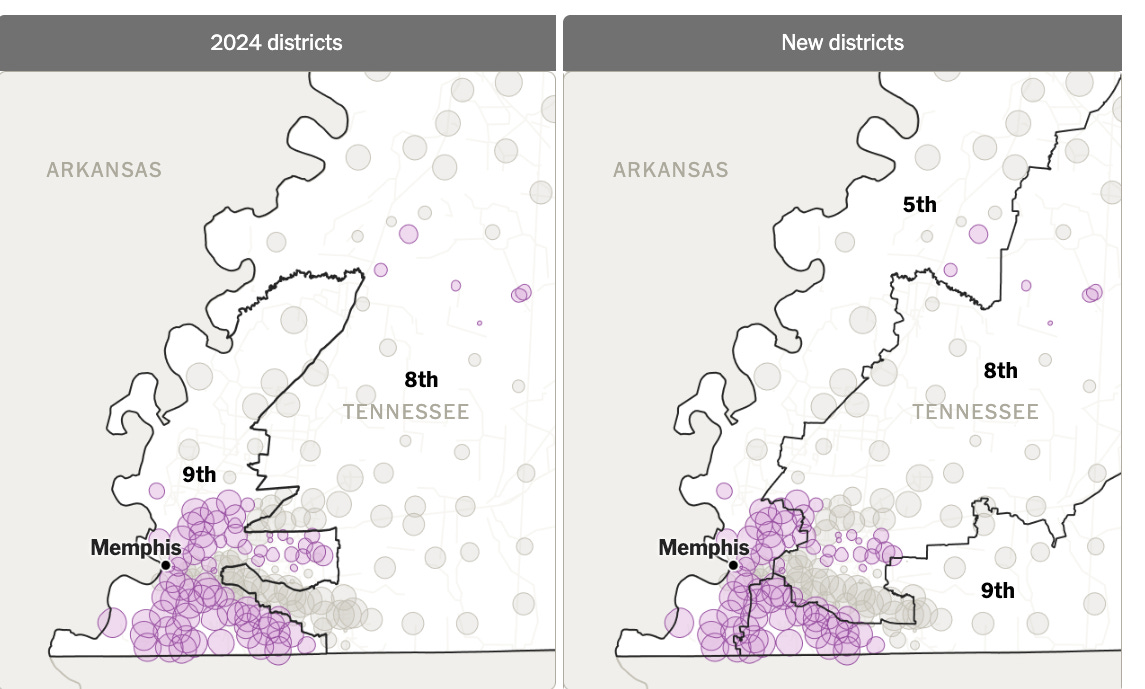
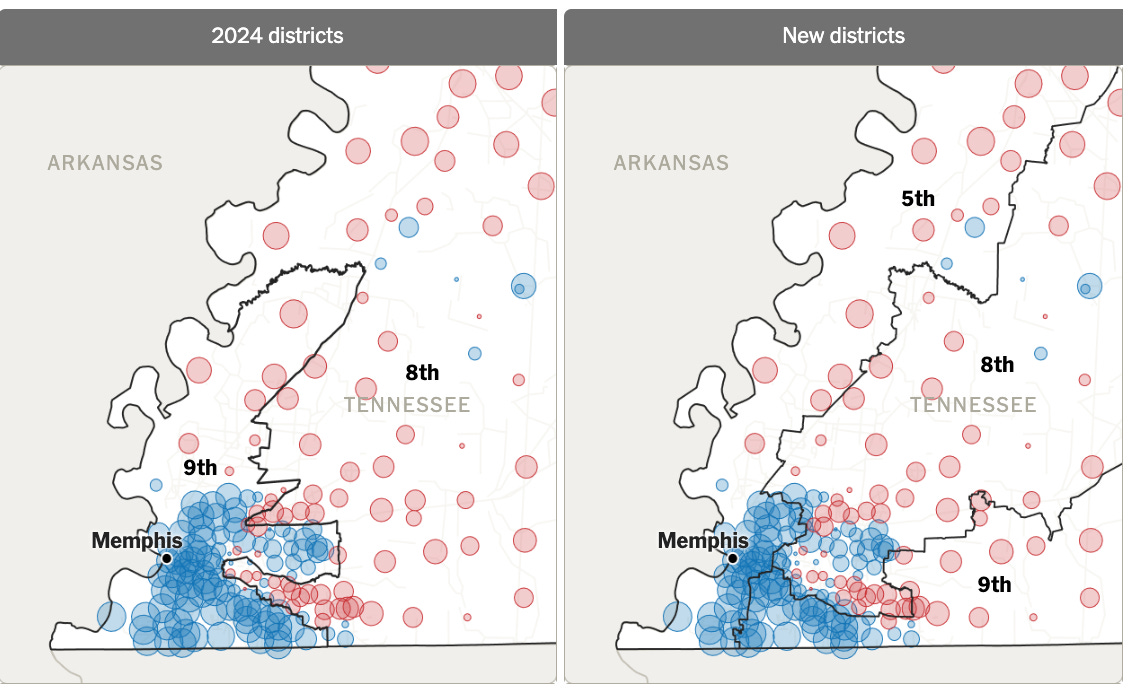
It is clear that this would have violated the Gingles test in a pre-Callais world, but we no longer live in that world sadly.
Now, TN-09 is a machination of TN-09, 08, and 05. TN-09 is now expected to be roughly R+10.
No, it’s not racist to have a majority-Black district
Now, republicans can claim this is simply a partisan gerrymander that has “nothing to do with race.” Or in the case of Rep. Jeremy “pulled a high school basketball referee’s pants down” Faison, claim that its obviously unfair to draw a district as majority Black, because that’s reverse racism…or something.
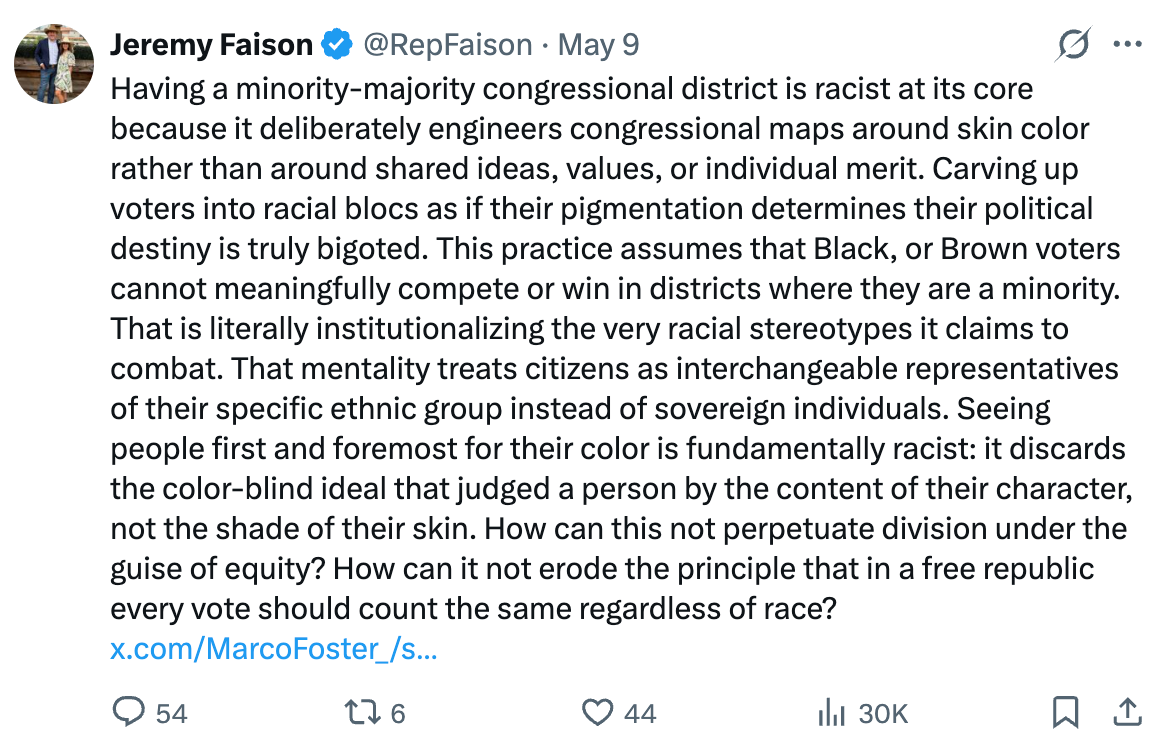
This is one of the biggest problems when it comes to redistricting in a post-VRA section 2 world: those who lack the historical context that led to the VRA won’t be equipped to understand why Faison’s explanation is based on flawed logic. It ignores the lack of voting power Black people had, and continue to have.8
A majority-Black district isn’t suggesting “all Black people think alike”, they are a response to existing demographic realities and to a political system that has historically discriminated against Black voters, and are a remedy for systems where minority voters would otherwise consistently lose representation despite large enough populations.
Its reality that Black people have many shared experiences that white people do not. Likely because of this, Black populations have a tendency to vote similarly when it comes to choosing democrats over republicans.
The Republican favorite to win the new seat is already taking victory laps
It took zero time for one of the state senators who voted for the new maps to announce they’d be running for the newly drawn 9th district seat9, with the backing of several prominent state republican politicians.
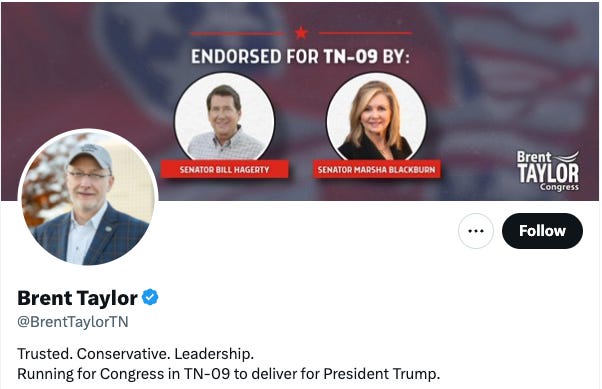
He has made it abundantly clear that his only goal is to be a rubber stamp for Donald Trump - it is his entire purpose in running, and presumably in life at this point.
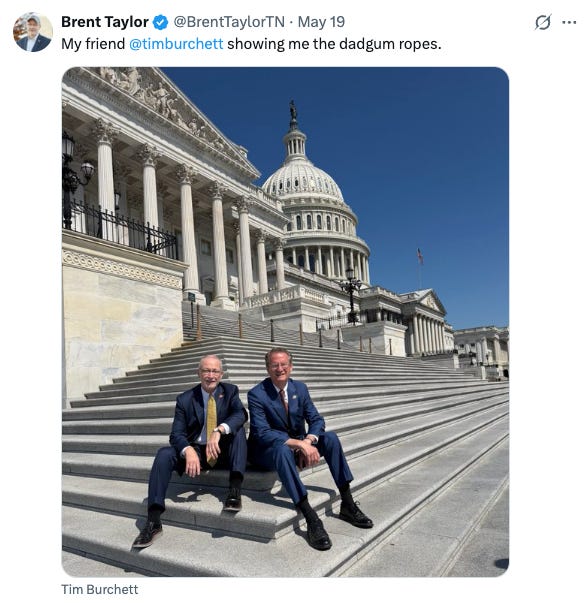
He has already declared victory in some ways, such as showing up at the US Capitol building with TN-02 Rep. Tim Burchett. Sad.
What would be extremely satisfying is if the democratic candidate could pull an upset. That person is Rep. Justin J. Pearson - a state rep from Memphis who rose to national prominence when he was expelled from the state house in 2023 after protesting and “violating decorum”.10
Rep. Pearson is a force to be reckoned with and a well-known leader in Memphis, and if anyone could pull this off I believe it is him. If you want to support his campaign, you can do so by checking out this link (not a paid ad, of course, I just support Rep. Pearson in this race personally and think him defeating institutional racism in such a way would be incredibly meaningful).
This isn’t the first time the TNGOP has destroyed a solid D district
As a bit of a sidebar to this whole conversation, I think its relevant to mention how Nashville’s congressional district suffered a similar fate — though with less racially-motivated implications.
Nashville’s congressional district was blown into oblivion in 2022, and most — including ya boi — saw it from a mile away. Back in 2018, I was playing with a now-defunct tool on the now-defunct website 538 known as the “Atlas of Redistricting.” It was an incredible tool that allowed you to, among other things, digitally redraw congressional districts in the most favorable way possible for Republicans. When you did that simulation, Nashville’s got wiped off the map. I’ve shown how below:
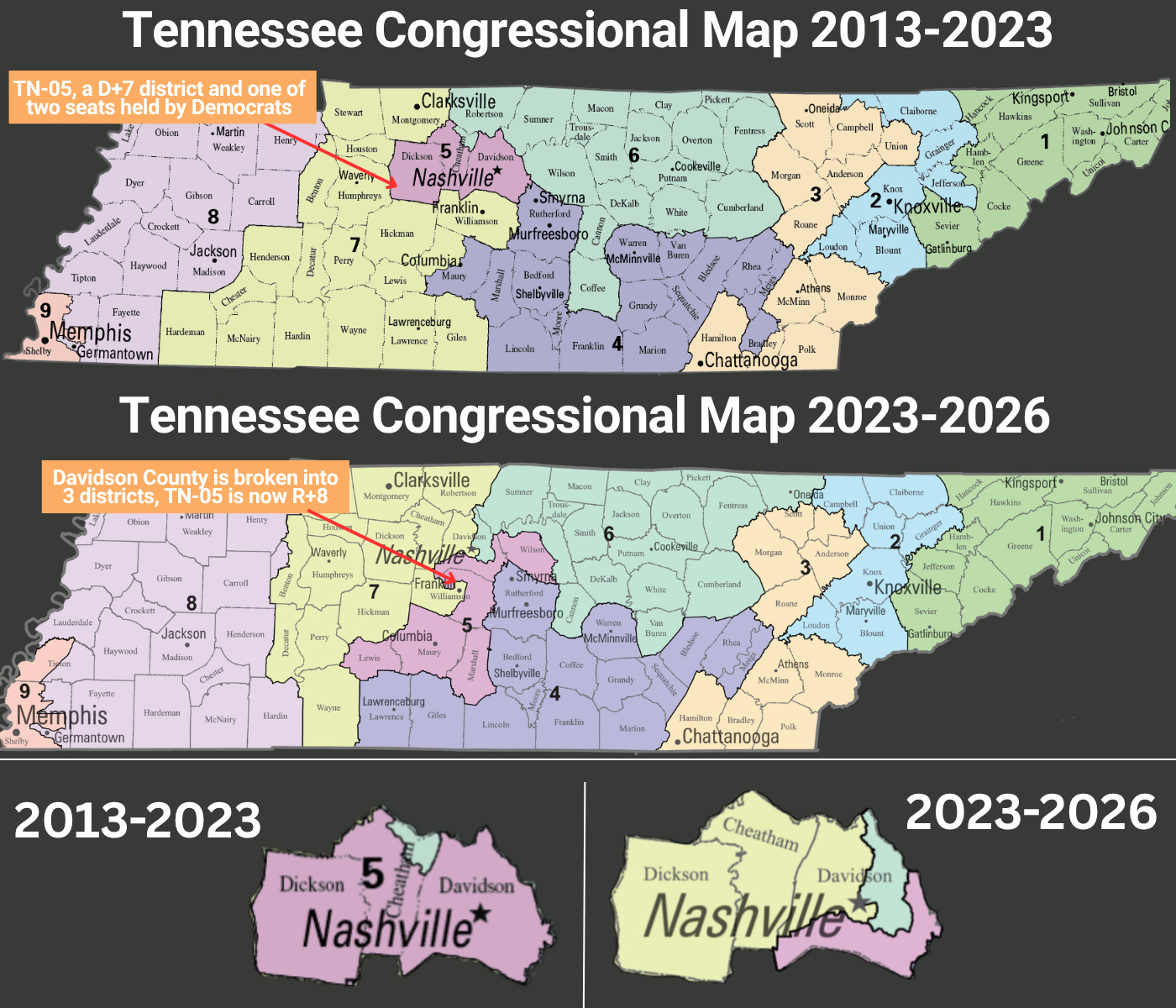
Nashville — one of two big “blue” cities in Tennessee — is a consolidated government, so it is technically the Metropolitan government of Nashville-Davidson County. Davidson County votes pretty blue, so Republicans broke it apart into three districts.
Coincidentally, or perhaps not, this redistricting also happened when a young Black person was challenging the entrenched incumbent Democrat. In this case, Odessa Kelly — an incredible community organizer in Nashville whom I got to know when I was in the 2018 New Leaders Council cohort — challenged 16-term incumbent Jim Cooper.
You’ve reached the end
If you have made it this far, thank you. I appreciate you taking the time to read this lengthy post, as I know it is atypical of me to write this much — especially about a topic that isn’t directly related to Appalachia.
I hope you’ve found this to be helpful in understanding the implications of what is happening in Tennesse, because it will not be isolated to this state. Other states are already trying to shatter the few majority-Black districts that remain in the South. I fear that, without an intervention from the courts or a democratic party that regains power and grows a spine, we will continue to regress back to Jim Crow era voting discrimination.
For me, it’s Cherry Coke Zero
To provide more specific detail: the amendment made it so that in order to prove a voting practice or procedure unalwfully discriminatied on the basis of race, you no longer had to show discriminatory intent - you only had to show that the outcome was inherently discriminatory. Second, it allowed you to make this case based on the totality of the circumstances “of the challenged mechanism” (in this case, the maps), not alone in the direct operation of the challenged mechanism - meaning the court could take into consideration the historical, social, and political factors surrounding vote dilution. This obviously made the barrier to prove their claim significantly lower.
The Gingles test required plaintiffs prove the existence of three preconditions to satisfy a claim for Section 2: (1) The racial or language minority group “sufficiently large and geographically compact to constitute a majority in a single-member district, (2) The minority group is “politically cohesive” (meaning its members tend to vote similarly); and (3) The “majority votes sufficiently as a bloc to enable it ... usually to defeat the minority’s preferred candidate
Putting these here so they don’t clog up the text, and because its helpful context but not wholly necessary:
Vast social change making great strides, particularly in the South, toward ending entrenched racial discrimination
A two-party system and frequent correlation between race and party preference (racial polarization)
People have an incentive (based on a previous SCOTUS case) to repackage gerrymandering claims as racial gerrymandering claims
Advances in computing capabilities make it easier to achieve calculated racial balances
It is the second largest (or largest, depending on what numbers you look at for Detroit) majority-Black cities in the U.S.
There has been a lot of hemming and hawing about Steve Cohen being white, and how that undermines the argument that redistricting would deprive Black voters of bloc voting power. This is a patently stupid fucking argument, and quite honestly a racist one. It presumes that Black people only elect other Black people to represent their interests, and also ignores the fact that the seat was held by the politically powerful Ford family — who are Black — for twenty years prior to Cohen.
Though one seat in a body of 538, it would be a critical pick-up for Republicans. The House has a razor thin majority at the moment, and Democrats — despite being one of the most functionally incompetent national parties in existence — are still heavily favored to take back the chamber in the fall, mainly due to Trump’s catastrophic decisions to invade Iran and generally terrible governance.
Many republican lawmakers understand this and either a) do not care, or b) reject it because we’ve solved racism or something according to them
Very painfully obvious this had been planned as soon as they knew the results of Callais. Let’s be for fuckin real here.
If you recall at the time, this group of lawmakers were known as the Tennessee Three. It is notable that he and his other colleague who was expelled at the time, Rep. Justin Jones, are Black. The one member of the Tennessee Three that wasn’t expelled was Rep. Gloria Johnson, a white woman.
This was my favorite post to read thus far. Even though it doesn't mention Appalachia, sometimes the ones that don't mention it are the most Appalachian of them all. This was one. Thank you for doing the deep-dive research and providing a more concise version for the rest of us. Keep it up. Looking forward to more deep-dives on important topics that impact the fate of America, Appalachia, and the world.