

Who gets to tell the story of Appalachia?
A new art exhibit in NYC has faced criticism from a collective of artists in Appalachia. I have some thoughts.

Appalachians are rarely afforded the opportunity to tell our story to a large audience. Instead, our stories often get told by people from outside the region - those who get to set the tone and framing in the way of their choosing. In other words, energy resources aren’t the only thing that gets extracted by people outside the region.
An NYC art exhibit about Appalachia, told from the perspective of a visitor
I received an email a few weeks ago from an artist and art historian named Ali Printz calling attention to an art exhibit in New York City about Appalachia. Ali is originally from West Virginia, and has dedicated her career to elevating Appalachian art and culture in museums and institutions. Her email described in detail how the exhibit repeated this unfortunate pattern of non-Appalachians telling Appalachian stories with their own spin on it. Here is some of how she framed it:
There is currently an exhibition at the Queens Museum in NYC called "The Great Society" that was mounted by a Swedish artist named Fia Backstrom. She went into the community of Buffalo Creek, West Virginia as an outsider and created a body of work around her own experience that is filled with stereotypes and cultural comparisons that elevate her own privileged background. I was shocked at the imagery and documentary footage that Backstrom featured and why she chose to focus on Buffalo Creek as a European outsider.
Ali also spoke about the power dynamics this created, among other things.
Needless to say, I read this and was interested in learning more. My full interview with Ali can be found here, but I wanted to expand on some thoughts below. While I wasn’t able to make it to the Queens Museum when I was in NYC earlier this month, I was able to see much of the exhibit through images that Ali shared with me from her and the GRIT Collective’s visit.
Playing the hits: poverty, exploitation, and stereotypes
It doesn’t take a Ph.D. in Appalachian Studies1 to know that there has been a history of extractive exploitation and poverty in Appalachia. This story has been told time and time again throughout our history. Yet, the Great Society chose to focus exclusively on this.
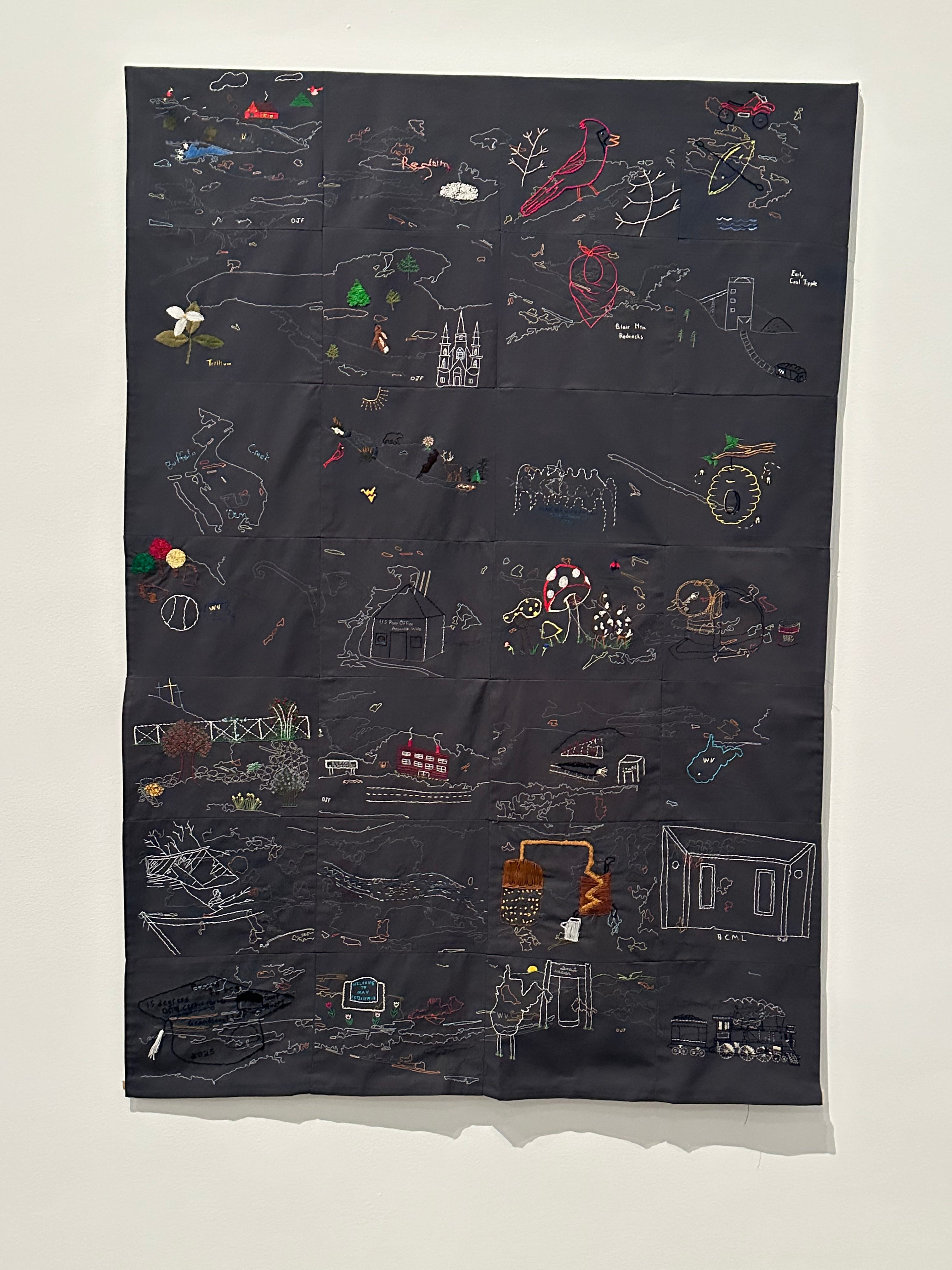
The artist is a native of Sweden who is an art professor and curently lives in Bed-Stuy Brooklyn. A New York Times article about the exhibit asks her why she chose this subject, and the answer is…well…not shocking if you’re from here I guess.
What sparked the idea for this portfolio of artworks?
After the 2016 election, the news was filled with articles about people, including those who lived in West Virginia, who were called everything from “baskets of deplorables” to “trash.” I wanted to meet people who were the target of this stereotyping to understand it firsthand.
Nice.
If you’re trying to avoid stereotypes about West Virginians, it’s usually best to rely on nuance rather than broad generalizations. In that vein, I’d recommend not immediately associating West Virginians with Hilary Clinton’s “basket of deplorables” comments.2
The exhibit doesn’t feature any faces of the people of Buffalo Creek. The above referenced article about the exhibit is quite literally titled “An artist explores community, without the people.” The artist’s entire calling card is that she does not photograph people. There is, of course, artistic value in doing this depending on the context. But telling a story about Appalachia, especially one where you focus almost exclusively on the utter despair and sorrow, necessitates a perspective of people who have lived it — not those perspectives curated by an observer.
That’s not to dismiss the very real tragedies that have occurred at Buffalo Creek and other parts of Appalachian coal country, and lord knows I’ve stood on my soapbox for many years hurling every expletive in the book at the likes of Don Blankenship and others, but this story is not the only story. And it also the story that has been told over and over again. AND it is likely the only story most people know about coal country.
I think this exhibit treats the people of Buffalo Creek as subjects to be pitied and felt bad for beause they are downtrodden. While the stories of real tragedy and trauma are important to tell, they are not and cannot be the only stories about Appalachia. Yet, it often seems that those are the only stories people with large platforms are willing to tell.
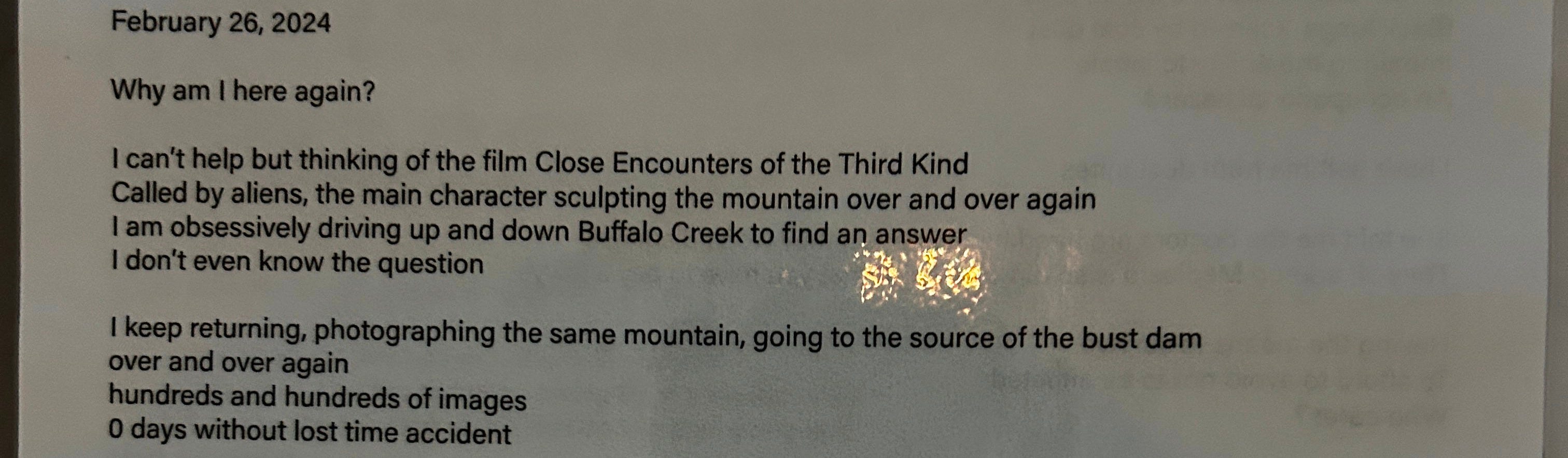
As the above image suggests, the artist’s reference to Close Encounters of the Third Kind likens the people here to an “alien” or “unfamilar” entity…kind of a strange thing to say when you’re trying to give a nuanced, sympathetic ear to a people.
My takeaway
I encourage you to listen to my interview with Ali, because her perspective is infinitly more detailed and valuable. One thing I will say is that I appreciate an earnest attempt at trying to understand the complexity of a place like Appalachia — particularly coal country — but it doesn’t sit well with me when other people try and tell that story primarily from their own perspective.
That’s not to say someone who isn’t from Appalachia cannot use their platform and talents to help tell the story. There can, and their has been. And I’m certainly not the gatekeeper of what is/isn’t acceptable when it comes to this.
When it comes to evaluating storytelling about Appalachia from someone outside the region I try to rely on two things: 1) do I feel it is a fair, accurate, and helpful representation, and 2) what has the reaction been by others from the region, especially those personally connected?
When I think about this particular exhibit, I am much more inclined to rely on the perspective of Appalachian artists — especially ones who went to view it in person. GRIT shared this about the exhibit on Instagram:
We write in response to the exhibition The Great Society at the Queens Museum.
Artist Fia Backström approaches West Virginia as a site of research rather than a living community. Her methodology reproduces the same extractive gaze that has historically defined relationships between outsiders and Appalachia — mining stories, aesthetics, and trauma for cultural capital.
.
This exhibition is not our story told by us.
.
It is a story about us, told by an outside artist, and framed by an outside institution.
.
Representation carries power. When museums present work through documentary forms, audiences understand it as truth. But without collaboration, accountability, or regional authorship, this authority reinforces stereotypes rather than dismantling them.
.
The exhibition focuses almost exclusively on trauma and despair, while failing to acknowledge the strength, complexity, pride, and humanity of our communities.
.
Appalachia is not an abstract concept.
.
It is our home.
.
Cultural institutions have a responsibility to engage communities with care, humility, and
equity.
.
These places are not sites for extraction. They are living, evolving cultures.
.
We call for accountability.
We call for dialogue.
We call for structural change
This art project uses the prestigious platform of the Queens Museum to tell their version of a story about our region that is too often told by those who never experienced the environmental degradation, disaster capitalism, and chronic poverty firsthand. Making a project like this faceless and with only a curated perspective of the people who experienced it renders it unable to accomplish what it set out to do: tell the story of extraction in Appalachia.
Giving Appalachians a platform like this to tell their story through their own unique artistic expression would certainly do the museum’s audience more justice, in my opinion.
A subject that was done away with at West Virginia University during the tenure of E. Gordon Gee, one of Leslie Wexner’s buddies.
It’s been almost a decade since Clinton dropped this line of nuclear-grade stupidity and condescension (a campaign with no shortage of those), but its worth noting that she actually said this line twice: once during a fundraiser in NYC, and once in an interview with Israel’s Channel 2 (you really can’t make this stuff up).
Just imagine how fucked off the people of, say, Brooklyn would be if a West Virginian went there and talked about how no one knew what hard work really was because they didn’t face the daily risks of being killed by their working environment. Or if a WV based author were to (RIGHTLY) point how criminals who killed thousands upon thousands of Appalachians have their names on museums there, honoring the “charity” of pieces of shit like the Sacklers.
Why not a photo exhibition of rich people in Appalachia — coal executives, investors and politicians?